What is a non-woven filter?
You see "non-woven filter" on products from face masks to air conditioners. But the term is confusing, leaving you unsure if you're getting a high-tech material or just a simple fabric.
A non-woven filter is one of the four main types of filter media, alongside woven fabric, paper, and membranes. It's a sheet of fibers bonded together—not woven—and is used for everything from high-efficiency particle capture to simple structural support.

The world of filtration is complex, but non-wovens play a huge role in it. The key thing to understand is that "non-woven filter" isn't a single product. It's a broad category. The way the fabric is made completely changes its job. Some non-wovens are the star players, designed to trap the tiniest particles. Others are the essential support structure, providing the strength and shape that allows the whole filter to work. Let's break down these two key roles.
What are the main jobs of non-woven filters?
You're trying to design a filter and all the non-woven options seem alike. Choosing the wrong type could mean your filter fails, lacks structure, or is inefficient.
Non-woven filters have two primary functions. The first is high-efficiency filtration, performed by materials like meltblown fabric that capture microscopic particles. The second is structural support, provided by stronger fabrics like our thermally-bonded material, which gives the filter its shape and durability.

Think of a modern composite filter as having a hero and a sidekick. The hero is the filtration layer. This is often a meltblown non-woven. It's made by extruding incredibly fine polymer fibers that form a dense, chaotic web. This web is fantastic at trapping tiny airborne particles like dust, pollen, and bacteria. However, this high-performance layer is often very delicate and flimsy, like a piece of tissue paper.
That's where the sidekick comes in: the support layer, or what we call a scaffold material. This is where my company's products shine. This layer isn't designed to catch microscopic dust. Its job is to be strong, stiff, and stable. It provides the backbone for the delicate meltblown layer, holding it in place so air can pass through it correctly. Without the support material, the filtration material would tear or collapse.
| Filter Component | Primary Role | Common Material | Key Characteristic |
|---|---|---|---|
| Filtration Layer | Traps tiny particles | Meltblown Non-woven | High-efficiency, delicate |
| Support Layer | Provides strength & stiffness | Thermally-Bonded Non-woven | Durable, structural |
How is an eco-friendly support material made?
You need a filter support material that is rigid and strong. However, you're concerned that many options achieve this stiffness by using chemical glues or binders you'd rather avoid.
Our eco-friendly support material is made using a dry-laid thermal bonding process. We blend standard polyester fibers with special low-melt fibers. When heated, the low-melt fibers fuse everything together, creating a stiff sheet without any chemical additives.
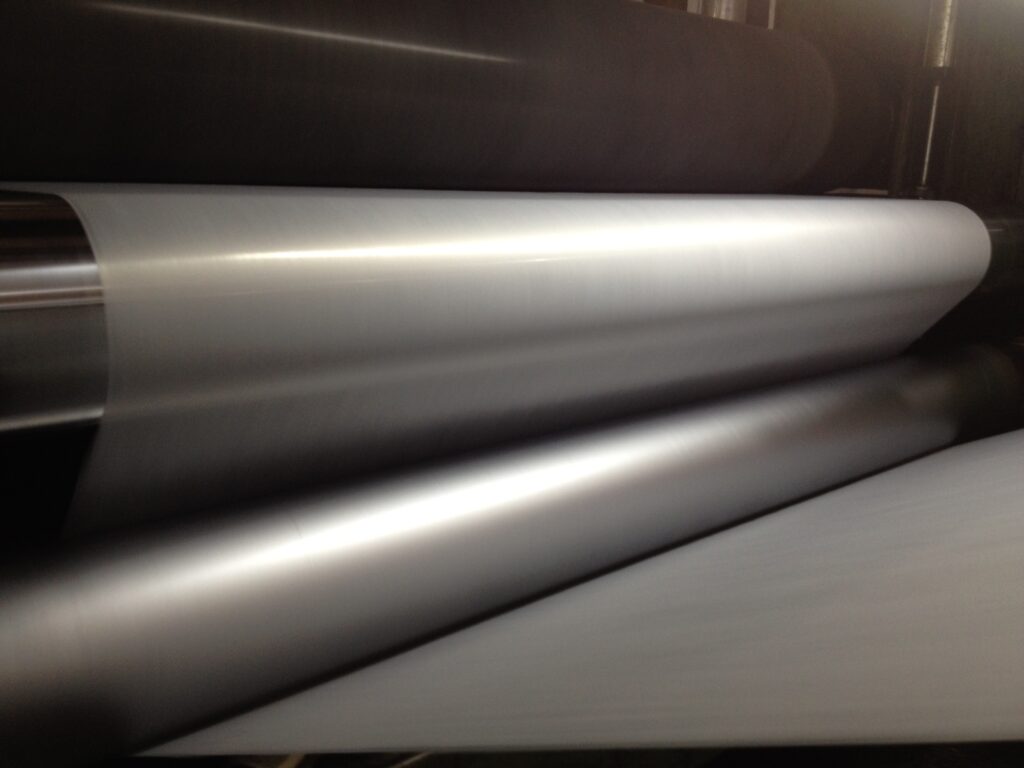
At my factory, we specialize in making this kind of support material. The process is quite clever and avoids the need for chemical adhesives. We start by taking two types of polyester staple fibers: regular PET fibers for strength and special bicomponent fibers that have a lower melting point.
First, we use a carding machine to comb and align these fibers into a uniform, fluffy web. This web then travels to a set of large, heated rollers. The temperature of the rollers is set precisely—hot enough to melt the outer sheath of the low-melt fibers, but not hot enough to affect the standard fibers. As the web passes through, the low-melt fibers turn sticky and act like millions of tiny glue spots, bonding the entire structure together. Once it cools, the result is a rigid, stable, and porous sheet. This method is incredibly clean. Because we don't use any chemical binders, it's a very environmentally friendly choice for filtration. While it may not be as stiff as some wet-laid materials at the same weight, it offers an excellent balance of performance and purity that many markets now demand.
Why is stiffness important for a support material?
You understand the support material needs to be strong, but why is stiffness so critical? You wonder if a softer, more flexible fabric could do the same job.
Stiffness is critical because it prevents the filter from deforming under airflow. A rigid support material maintains the filter's shape, ensuring air passes evenly through the filtration layer and preventing the delicate media from collapsing or tearing under pressure.

Imagine what happens inside an air handling unit or even a simple box fan. The fan creates air pressure. This pressure pushes against the filter media. If the support material is not stiff enough, the filter will bend, buckle, or even get sucked into the fan. This is called filter collapse.
When a filter deforms, two bad things happen. First, air will always follow the path of least resistance. It will rush through any gaps or bypass the collapsed areas, meaning a large portion of the air isn't being filtered at all. The filter's efficiency plummets. Second, the collapse puts immense stress on the delicate high-efficiency filtration layer. This can cause it to tear, creating a hole that lets all the dust and contaminants pass straight through. Our job as a manufacturer of support material is to carefully control the blend of fibers and the thermal bonding process to achieve the exact level of stiffness our clients need for their specific application, ensuring the filter performs reliably throughout its entire service life.
Conclusion
A non-woven filter is a versatile material used for either particle capture or structural support. The manufacturing method defines its function, from delicate meltblown layers to strong, eco-friendly thermally-bonded support backings.
Li Sun
With over 15 years of experience in non-woven fabric manufacturing, I lead our R&D team at Hangzhou Golden Lily. My expertise includes developing innovative filtration materials and sustainable packaging solutions.